I’ve been tulle-wrangling lately…

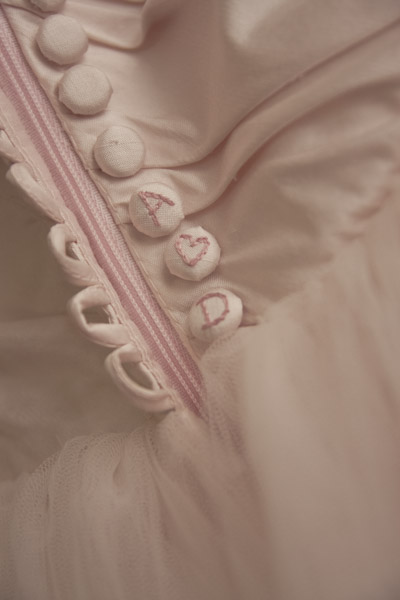
Some things are going well, like the boned foundation of the bodice.

Others I am not sure of, but am waiting to see how they turn out, like draping bias cut silk over the bodice.  (After the photo this was clipped back to seam allowance and sewn down to the foundation.)  I’m not sure that it’s not too busy.

Other things are causing me to lose sleep, like this enoooormous skirt.  (we ran out of tulle for the final tier, probably a good thing).

I think it needs to go back to being more like this.

So this is why wedding dresses are stressful.  It’s not just that there are more intricate foundations to reckon with.  The hardest part is that it’s a once in a lifetime dress: it’s hard to call it ‘good enough’ and move on.

On with the wedding dress fun!  These photos are from Friday, when I spent some hours in Ringwood with bridalwear expert Julie Spencer.  I’m so glad that I a) decided to find some help and b) found Julie and her friend and colleague Karen.  I must have called twenty dressmakers and more pattern makers in an attempt to find someone who’d teach me as they worked.  Whilst I understand their reluctance to have me hanging around, slowing them down and wanting to do things myself, learn how things are done, it was frustrating.  Calling all dressmakers: you could make a mint in private sewing lessons with a bridal focus.

First of all, off to ‘The House of Franke, Stuart”.  Franke Stuart has been around for decades.  They once made dresses and now they sell a fabulous range of bridal fabrics and laces.  They also make hoop skirts.

I picked up a hoop skirt they’ve made for me, and fabric such as I have never even *held* before.  There’s a long length of pale blush dupioni is for the bodice and skirt, there’s 15m of soft tulle for the overskirt, a couple of short lengths of darker dupionis to ’see’ about layering in the skirt, and some organza.  All pinks, all as pale as possible.  The photos below are of a session ‘just playing’ with everything pinned together.   The skirt is sewn out of the basic dupioni and we used a strip of it to stand in for the bodice.

I also picked up a tiny bit of blush  lace and you can see it pinned to the first overskirt below.  I wonder if I can afford to stitch lace over the bottom edge of each overskirt.  That would be pretty, no?  What do you think?

I’m not going to use the darker dupionis though.  So I have to find some other use for that fabric.  It was worth trying though!

Yeah, it’s not going to work.  Simple is best.  That second skirt, though, is the organza, and I think (there are so many decisions to make!!  eek!) that it would be very sweet lined with the dupioni and made into a bow for the back waist?

There are almost too many possibilities!  So: I learned a few things.  For important and expensive dresses like bridal gowns, Julie uses a 2.5cm seam allowance so that the dress can be let out as well as in.  If the diet is a fail, no problem.  There are special feet that will gather up tulle and other fabrics and create ruffles and gathers: I didn’t know that.  And if your fabric is fine and you want to put only a light hem on it, don’t iron it over twice like you’d normally do.  Turn it with your finger, just a few millimetres, while sewing it down.  Turn again, sew again.  Light and easy.

Next lesson is scheduled for the 6th, when I’m going to bag out the skirt with its lining and build the overskirt layers.  This is So.  Much.  Fun.

Oh, and!  I want to ask you — five tulle skirts or three?  These are the important questions!

I’m writing a post for today about The Dress, but first there’s something I want to get off my chest: I don’t write this blog as often as I once did, or as often as I want to.  I know that some of you (particularly those who come to read at the site, rather than using a feed) are noticing the difference.

When I started this blog I was on an extended holiday between careers, and now that I have found a new vocation there’s an awful lot of work and retraining going on.  Because that vocation is sewing and designing, many things I do and make are relevant to the blog.  On the other hand, I’m balancing 3 days of paid work with 2 nights in school, at least 1 day a week of homework, a business in startup, managing a household while my fiance Dan finishes the hardest year of his own studies, and making a wedding for 90 guests happen.   Let’s be clear: I’m not complaining in the least.  I chose this (well, everything except the extra housework part).  But weeks will go by before I get the chance to sit down and write a post.  My hand quilting, too, is packed away for a little while.

In mid-February my course ends and we’ll get married.  Soon Dan will be a real human being again with the capacity to cook dinner and vaccuum occasionally.  Till then, I’ll be here when I can and I hope you stick around.


Today is Dart Day!  Hooray!

OK, now that I have that out of my system, I want to share with you a couple of little tricks I’ve picked up at night school.  Some of you will undoubtedly already know them but they’re not common knowledge.

Pattern makers don’t bother with time saving measures for home sewing.  However I’m yet to meet a home sewer who liked making darts.  There are many ways of marking them, and all are tedious.  All involve a lot of fiddling around, visually checking from one side of the fabric to another to make sure that all the marks line up.  Or thousands of pins. And it can be so hard to get them to the same length.

Professional sewers don’t have time to spare and they can’t afford to unpick and start again, so they use a combination of notches and drill holes.  It takes much less time, and it goes together better.  You should try it too!  You will need a tailor’s awl.  They’re very, very cheap.

First of all: what are you doing cutting around those crazy little diamonds in your patterns?  It’s not accurate and it slows you down.  Just cut clear around your pattern and then make notches no deeper than half the seam allowance.  Seriously.  Don’t be scared of damaging your garment.  Unless you’re using a flimsy fabric like silk chiffon, you won’t.

Try it, really.  In all your sewing.  Notches are awesome.  Diamonds are annoying.  OK, on to the dart.  First notch the tops of the dart.

Then get your tailor’s awl.  Stick it in through pattern and fabric, 1cm (1/2 inch) above the apex of the dart.  Really, it’s OK!  The awl is so sharp that it won’t tear your fabric.  It might break a thread but more likely it will just push threads out of the way and make a mark that will slip back into place with a little bending of fabric.  Besides, you are using the awl inside the dart.  The marked fabric won’t ever be under stress and it isn’t part of your garment.  It’s more like seam allowance than anything else.

Now the fun part!  Fold the dart over on itself as usual.  Isn’t it easy to line the tops up?  And all you need to do to make sure it’s lining up straight is to get the awl mark sitting flush with the fold.

Sew the dart as usual, starting with the notches and sewing past the awl point by that 1cm or 1/2 inch.  The last few stitches should only catch one thread.  I could have done better in the example below, but it’s good enough.  Tie the threads off and press.

Now, go forth and conquer!

OK, so I’ll have to admit, I can be headstrong.  I’ve been so insistent on making my dress myself, that I refused to even think about getting a dressmaker to help!   After three goes at building a bodice toile for my dress, and the same number of frustrated wollopings of fabric into the bin — too sad to blog about it — I called in the experts.

Isn’t it funny though, that as soon as you let your barriers down and ask for help, things seem to work out?  I’ve found two lovely ladies, one a patternmaker and one a dressmaker.  Julie and Karen worked together in a bridal store for twenty odd years, so they know what they’re doing, and they’re going to help me make The Dress in their homes as a kind of masterclass.  Instead of paying for dressmaking, I’m paying for guidance and learning new skills, which I much prefer.

Julie fit this final toile on me today (by the way, that skirt is just a placeholder bit of bemsilk, not the final pattern).  And I have bought such wondrous fabrics! Silk and organza and tulle…  but photos will have to wait until two weeks hence, when I promise to take photos of the cutting process.  It’s so nice to be excited about this again and I can’t wait to learn and share bridal construction techniques.

Dart class coming up tomorrow…

Plenty of quilters will fussy cut to get geometric patterns happening in their hexagons, but I’m going to show you something with a twist:  how to use large prints and motifs.  Such as this beautiful bird print.  I wish I could remember the name of it so I could get more, but as I have only a tiny amount left I want to preserve it in my quilt.  However the birds are each twice the size of my patches.

Though I haven’t shown it here, this is a great opportunity to use print motifs that have been sliced in half when your length of fabric has been cut from the roll, or are near the selvedge.  It also creates a sense of movement and difference, when it’s sewn in with plainer flowers, that I like a lot.

First, lay a patch over one motif.  You will need two motifs so two opposite halves, or one half and one whole, work nicely.  Consider carefully where the edge will go and how the patch will sit in your overall design.  Cut around the patch, leaving a generous — and I mean generous, like half an inch – seam allowance.

Pin the patch to the back of your paper and baste with your preferred method.  Then lay it over your second motif.

Nice!  You can hardly tell there’s a patch on there.  OK, now you need to lay a second paper patch nest door and pin it in place. 

Cut again, using another generous seam allowance.  With the pin still in place, finger press the fabric around the paper to mark placement.  Then remove the pin and move the paper to the back.  

The next step is the trickiest stage.  You will need to reposition the paper exactly, which usually means a couple of tries for me.  Take care that the sides match up as nicely as the long side.

Baste the paper to the second patch.  Check that everything’s still in place.  If not, you will have to take the basting out and try again — like I said, you need to have a lot of seam allowance and it’s fiddly.  But it’s worth it, as long as you’re not trying to fussy cut an entire quilt!    O_o 

Match them up and…

Sew together as per usual into…

A birdy flower!  Hooray!   Now you may cut away that bulky excess seam allowance.

Try this out for yourself — and please tell me in the comments if anything seems confusing, I’ll edit the tutorial. 

I have been very lax with blogging and I do apologise but on the up side, I have a super-exciting new project which I hope I can share with you soon.  In the mean time, there’s a special post coming up next in which I will share a way of making darts that will change your life for the better!  See you soon…

il_430xN.77802537

Remember me?  No?  I don’t blame you.  I’ve been pretty distant from the blog lately, what with night school, homework, *real* work, keeping the house — well, certainly not clean, but at least mostly navigable and waterproof — and starting a small business!  Agh!  Oh, and there’s that wedding thing I should be planning!!

But I do have something to show for myself.  Would you like to make a vintage sheet cushion?  I’ve written a pattern and it’s over in my Etsy store now for the bargain price of $5.  The pattern is suited to any fabric, really, but I’ve developed it with an interfacing method that’s super-good for preserving and making the most of precious scraps that have seen better days.

Oh, and to all of you who are teeming over (yes, that’s the word I want) from tipnut.com — hi!  Stick around and join the conversation :)

Enjoy.

6a00d8341caca853ef0120a519d3b0970b-800wi

It was my birthday on Wednesday, and what could be more exciting than finding oneself featured over at Modish?   I am afraid I may have shocked my co-workers  at the Library with my little yelp of joy!   And then, the very next day, Polka Dot Rabbit took one of these cushions home from the Little Shop of Handmade and blogged about it.  Birthday happiness!

Liz Grotyohann from Cosa Verde made the picture magic above.  Isn’t she a dab hand at mixing and matching photos?  I need Liz to come over to my house and decorate with her eco-friendly finds.  I think I’d be a better, happier person if she did that!

3761072511_c2cc52901b

There’s only one problem with my wedding dress pattern, but it’s a deal breaker.  Pointy 50s boob darts might have been great in 1953 but now they say LOOK AT ME I’M WEARING VINTAGE.  All the modern patterns I can find have princess seams, which are fine in general but not for this particular dress-of-my-dreams.

I bought this pattern today from the ever-fabulous sandritocat, fingers crossed.

Oh, can’t resist: “Oh, Matthew!  Puffed Sleeves!!”

Next Page »